LECTURES A GRATIS GLOBAL SERVICE
⌕ SEARCH GRATIS GLOBAL ↗
LECTURES
Cation Intermediates. Alkenes: Formation, Addition, and Stability
SOURCE: YOUTUBE · NO TRACKING UNTIL YOU PRESS PLAY · TROUBLE PLAYING? WATCH AT THE SOURCE ↗

Cation Intermediates. Alkenes: Formation, Addition, and Stability

51 MIN · EN · STATUS: [ STREAMING ]
RATE THIS
YALE · Freshman Organic Chemistry II with Michael McBride · LECTURE 10

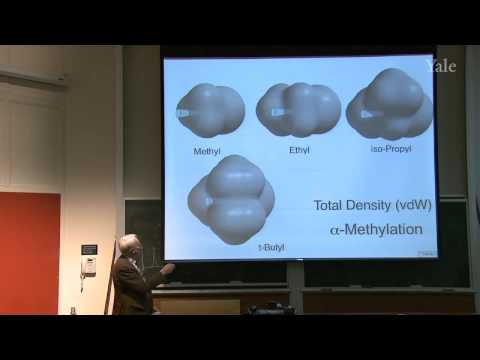
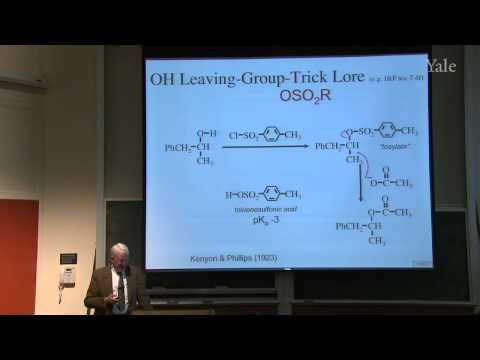
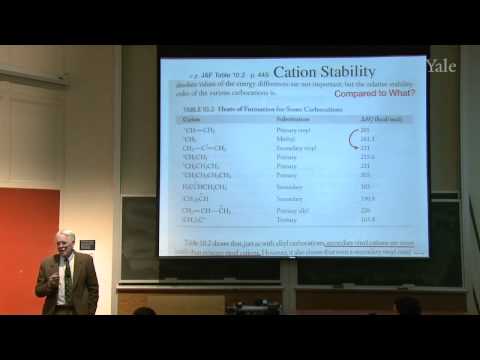
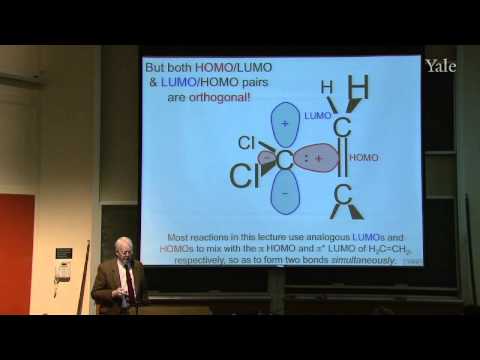
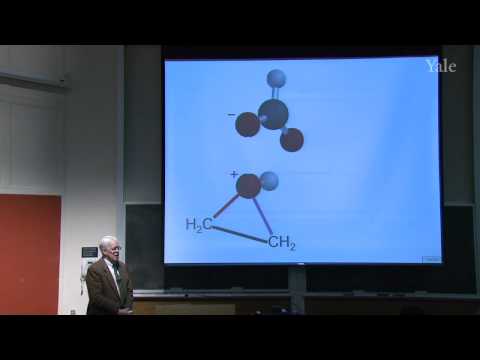
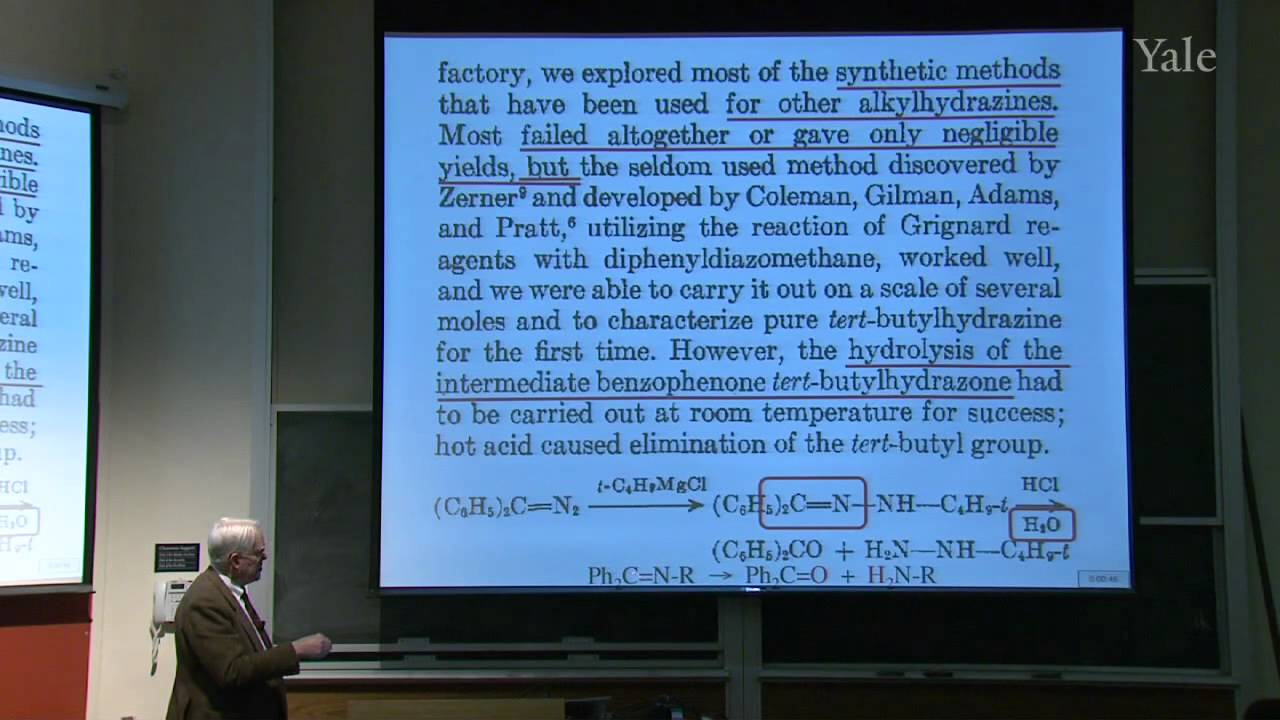
Yale's Freshman Organic Chemistry II (CHEM 125B), lecture 10 with Michael McBride. McBride examines how bridged pentavalent carbon structures act as intermediates or transition states during cation rearrangement in SN1 reactions, and how short-lived ion pairs account for net inversion of stereochemistry. He contrasts how preparative and mechanistic organic chemists interpret reaction yields differently, using a study of t-butylhydrazine designed to show that molecular rotation can become rate-limiting in viscous solvents. The lecture then turns to electrophilic addition to alkenes, framed as the reverse of E2 or E1 elimination and studied with analogous kinetic and stereochemical techniques. McBride closes by using NIST Webbook thermochemical data to compare the relative stability of isomeric alkenes. Recorded in Spring 2011, the lecture moves from mechanism to data with the blackboard derivations and reaction diagrams typical of the course.
More from this course

12 LECTURES
Mechanism: How Energies and Kinetic Order Influence Reaction Rates

Mechanism: How Energies and Kinetic Order Influence Reaction Rates

YALE · 49 MIN
Peculiar Rate Laws, Bond Dissociation Energies, and Relative Reactivities

Peculiar Rate Laws, Bond Dissociation Energies, and Relative Reactivities

YALE · 48 MIN
Rate and Selectivity in Radical-Chain Reactions

Rate and Selectivity in Radical-Chain Reactions

YALE · 47 MIN
Electronegativity, Bond Strength, Electrostatics, and Non-Bonded Interactions

Electronegativity, Bond Strength, Electrostatics, and Non-Bonded Interactions

YALE · 50 MIN
Solvation, H-Bonding, and Ionophores

Solvation, H-Bonding, and Ionophores

YALE · 47 MIN
Brønsted Acidity and the Generality of Nucleophilic Substitution

Brønsted Acidity and the Generality of Nucleophilic Substitution

YALE · 47 MIN
Nucleophilic Substitution Tools: Stereochemistry, Rate Law, Substrate, Nucleophile

Nucleophilic Substitution Tools: Stereochemistry, Rate Law, Substrate, Nucleophile

YALE · 52 MIN
Solvent, Leaving Group, Bridgehead Substitution, and Pentavalent Carbon

Solvent, Leaving Group, Bridgehead Substitution, and Pentavalent Carbon

YALE · 48 MIN
Pentavalent Carbon? E2, SN1, E1

Pentavalent Carbon? E2, SN1, E1

YALE · 48 MIN
Carbocations and the Mechanism of Electrophilic Addition to Alkenes and Alkynes

Carbocations and the Mechanism of Electrophilic Addition to Alkenes and Alkynes

YALE · 52 MIN
Nucleophilic Participation During Electrophilic Addition to Alkenes

Nucleophilic Participation During Electrophilic Addition to Alkenes

YALE · 49 MIN
Addition to Form Three-Membered Rings: Carbenoids and Epoxidation

Addition to Form Three-Membered Rings: Carbenoids and Epoxidation

YALE · 51 MIN