Solvation, H-Bonding, and Ionophores
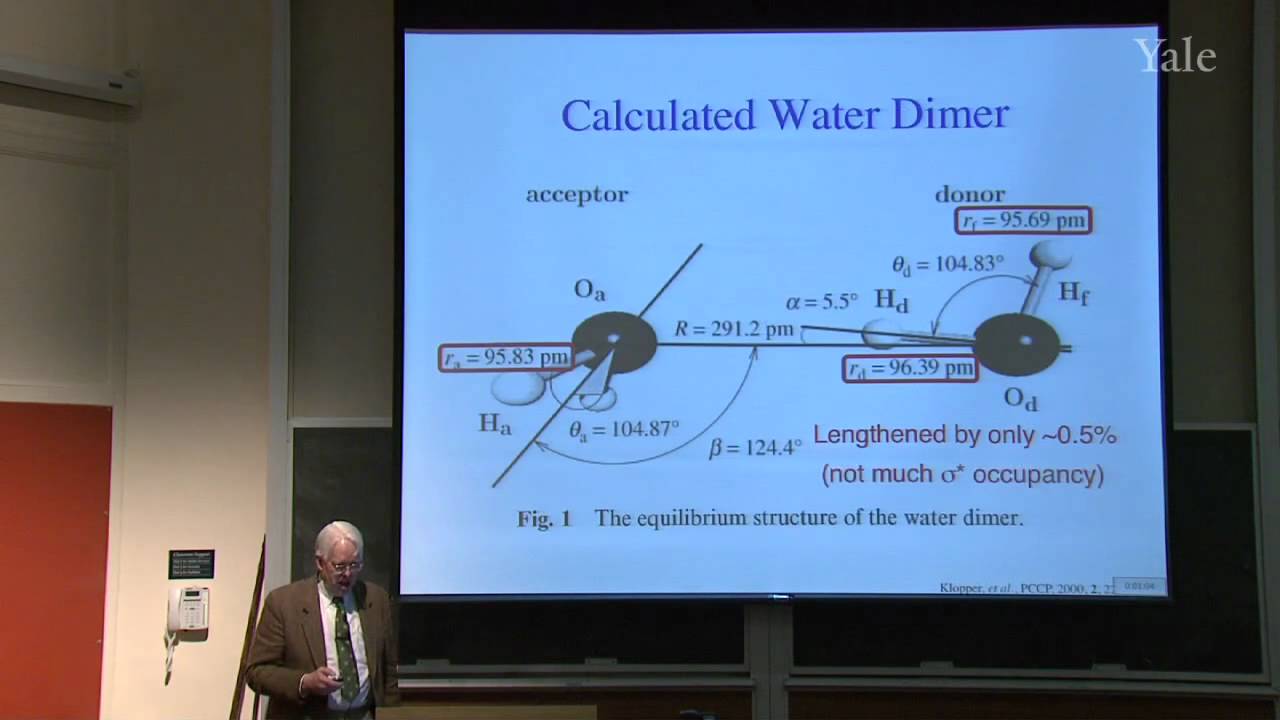
Michael McBride continues Yale's Freshman Organic Chemistry II with a lecture on how molecules behave in solution rather than in isolation. He opens with a puzzle about alcohol oxidation mechanisms before turning to solvation effects on boiling points and the idea of intramolecular solvation. The middle of the lecture covers solvophobic forces and hydrogen bonding as electrostatic and polarizability phenomena, then moves to ionophores, natural and artificial ion carriers that can be tailored to bind specific ions, and their role in phase-transfer catalysis. McBride closes by working through the energetics of gas-phase heterolysis, showing why ionic dissociation of water is prohibitively costly without a solvent. Recorded in spring 2011 as part of the Open Yale Courses series, the lecture builds its arguments on the chalkboard through worked structural and energetic reasoning rather than slides.