LECTURES A GRATIS GLOBAL SERVICE
⌕ SEARCH GRATIS GLOBAL ↗
LECTURES
Electronegativity, Bond Strength, Electrostatics, and Non-Bonded Interactions
SOURCE: YOUTUBE · NO TRACKING UNTIL YOU PRESS PLAY · TROUBLE PLAYING? WATCH AT THE SOURCE ↗

Electronegativity, Bond Strength, Electrostatics, and Non-Bonded Interactions

50 MIN · EN · STATUS: [ STREAMING ]
RATE THIS
YALE · Freshman Organic Chemistry II with Michael McBride · LECTURE 4

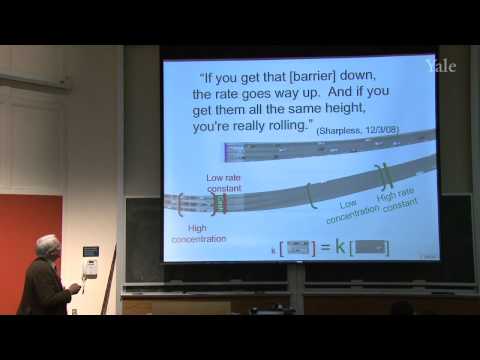
Michael McBride continues Yale's Freshman Organic Chemistry II with a lecture on the forces that weaken and strengthen chemical bonds. He opens with a student presentation generalizing fractional-order rate laws, then explains how lone-pair electron repulsion lowers bond dissociation energy. The core of the lecture works through Pauling's definition of electronegativity, showing how differences between atoms make heterolysis (ionic dissociation) easier while making homolysis (radical dissociation) harder, and flags the circularity built into Pauling's own logic for the latter effect. The lecture closes by pivoting from free-radical to ionic reaction mechanisms, examining the electrostatic properties of alkyl halides and alkanes and how solvents influence these reactions. Recorded in spring 2011 as part of the Open Yale Courses series, the talk is chalkboard-based and dense with worked reasoning rather than slides, suited to students already following the course sequence.
More from this course

12 LECTURES
Mechanism: How Energies and Kinetic Order Influence Reaction Rates

Mechanism: How Energies and Kinetic Order Influence Reaction Rates

YALE · 49 MIN
Peculiar Rate Laws, Bond Dissociation Energies, and Relative Reactivities

Peculiar Rate Laws, Bond Dissociation Energies, and Relative Reactivities

YALE · 48 MIN
Rate and Selectivity in Radical-Chain Reactions

Rate and Selectivity in Radical-Chain Reactions

YALE · 47 MIN
Solvation, H-Bonding, and Ionophores

Solvation, H-Bonding, and Ionophores

YALE · 47 MIN
Brønsted Acidity and the Generality of Nucleophilic Substitution

Brønsted Acidity and the Generality of Nucleophilic Substitution

YALE · 47 MIN
Nucleophilic Substitution Tools: Stereochemistry, Rate Law, Substrate, Nucleophile

Nucleophilic Substitution Tools: Stereochemistry, Rate Law, Substrate, Nucleophile

YALE · 52 MIN
Solvent, Leaving Group, Bridgehead Substitution, and Pentavalent Carbon

Solvent, Leaving Group, Bridgehead Substitution, and Pentavalent Carbon

YALE · 48 MIN
Pentavalent Carbon? E2, SN1, E1

Pentavalent Carbon? E2, SN1, E1

YALE · 48 MIN
Cation Intermediates. Alkenes: Formation, Addition, and Stability

Cation Intermediates. Alkenes: Formation, Addition, and Stability

YALE · 51 MIN
Carbocations and the Mechanism of Electrophilic Addition to Alkenes and Alkynes

Carbocations and the Mechanism of Electrophilic Addition to Alkenes and Alkynes

YALE · 52 MIN
Nucleophilic Participation During Electrophilic Addition to Alkenes

Nucleophilic Participation During Electrophilic Addition to Alkenes

YALE · 49 MIN
Addition to Form Three-Membered Rings: Carbenoids and Epoxidation

Addition to Form Three-Membered Rings: Carbenoids and Epoxidation

YALE · 51 MIN