LECTURES A GRATIS GLOBAL SERVICE
⌕ SEARCH GRATIS GLOBAL ↗
LECTURES
Rate and Selectivity in Radical-Chain Reactions
SOURCE: YOUTUBE · NO TRACKING UNTIL YOU PRESS PLAY · TROUBLE PLAYING? WATCH AT THE SOURCE ↗

Rate and Selectivity in Radical-Chain Reactions

47 MIN · EN · STATUS: [ STREAMING ]
RATE THIS
YALE · Freshman Organic Chemistry II with Michael McBride · LECTURE 3

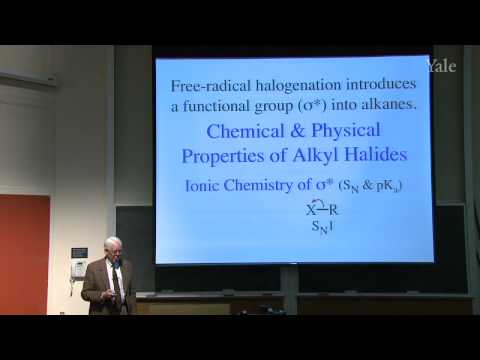
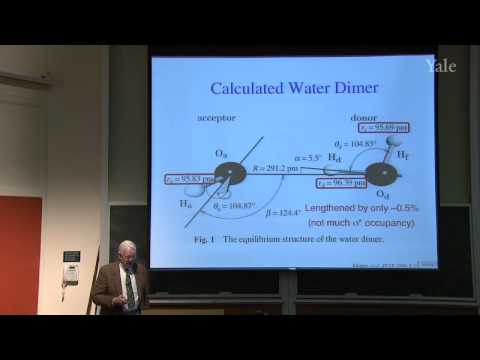
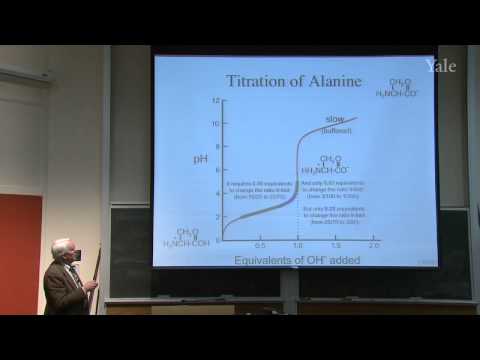
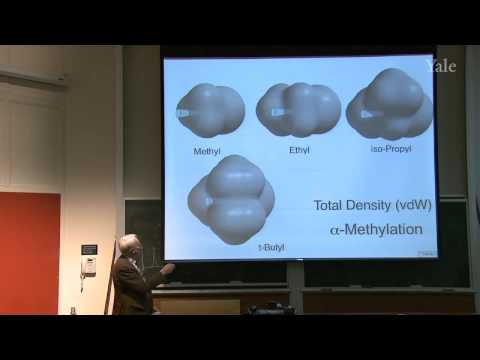
Michael McBride continues Yale's Freshman Organic Chemistry II with a lecture on radical-chain reactions. He opens with the reactivity-selectivity principle, explaining why bromine atoms discriminate more than chlorine atoms when abstracting hydrogen from carbon. He then works through the free-radical mechanism for HBr addition to alkenes, showing how it produces anti-Markovnikov regiochemistry rather than the ionic pathway's usual product. The middle of the lecture turns to kinetics, deriving rate laws for catalytic halogenation cycles and showing how chain termination steps can make the overall rate half-order in initiator concentration. The final segment examines how protonation and ionic charge on radicals and their reaction partners can override the expected regiospecificity. Recorded in Spring 2011 as part of Yale's CHEM 125B, the lecture runs through four chapters moving from qualitative principle to quantitative rate-law derivation, aimed at students already grounded in basic organic mechanisms.
More from this course

12 LECTURES
Mechanism: How Energies and Kinetic Order Influence Reaction Rates

Mechanism: How Energies and Kinetic Order Influence Reaction Rates

YALE · 49 MIN
Peculiar Rate Laws, Bond Dissociation Energies, and Relative Reactivities

Peculiar Rate Laws, Bond Dissociation Energies, and Relative Reactivities

YALE · 48 MIN
Electronegativity, Bond Strength, Electrostatics, and Non-Bonded Interactions

Electronegativity, Bond Strength, Electrostatics, and Non-Bonded Interactions

YALE · 50 MIN
Solvation, H-Bonding, and Ionophores

Solvation, H-Bonding, and Ionophores

YALE · 47 MIN
Brønsted Acidity and the Generality of Nucleophilic Substitution

Brønsted Acidity and the Generality of Nucleophilic Substitution

YALE · 47 MIN
Nucleophilic Substitution Tools: Stereochemistry, Rate Law, Substrate, Nucleophile

Nucleophilic Substitution Tools: Stereochemistry, Rate Law, Substrate, Nucleophile

YALE · 52 MIN
Solvent, Leaving Group, Bridgehead Substitution, and Pentavalent Carbon

Solvent, Leaving Group, Bridgehead Substitution, and Pentavalent Carbon

YALE · 48 MIN
Pentavalent Carbon? E2, SN1, E1

Pentavalent Carbon? E2, SN1, E1

YALE · 48 MIN
Cation Intermediates. Alkenes: Formation, Addition, and Stability

Cation Intermediates. Alkenes: Formation, Addition, and Stability

YALE · 51 MIN
Carbocations and the Mechanism of Electrophilic Addition to Alkenes and Alkynes

Carbocations and the Mechanism of Electrophilic Addition to Alkenes and Alkynes

YALE · 52 MIN
Nucleophilic Participation During Electrophilic Addition to Alkenes

Nucleophilic Participation During Electrophilic Addition to Alkenes

YALE · 49 MIN
Addition to Form Three-Membered Rings: Carbenoids and Epoxidation

Addition to Form Three-Membered Rings: Carbenoids and Epoxidation

YALE · 51 MIN