Nucleophilic Substitution Tools: Stereochemistry, Rate Law, Substrate, Nucleophile
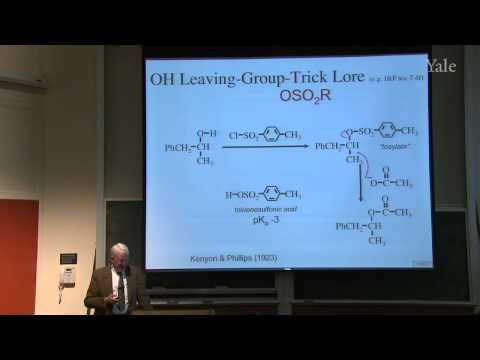
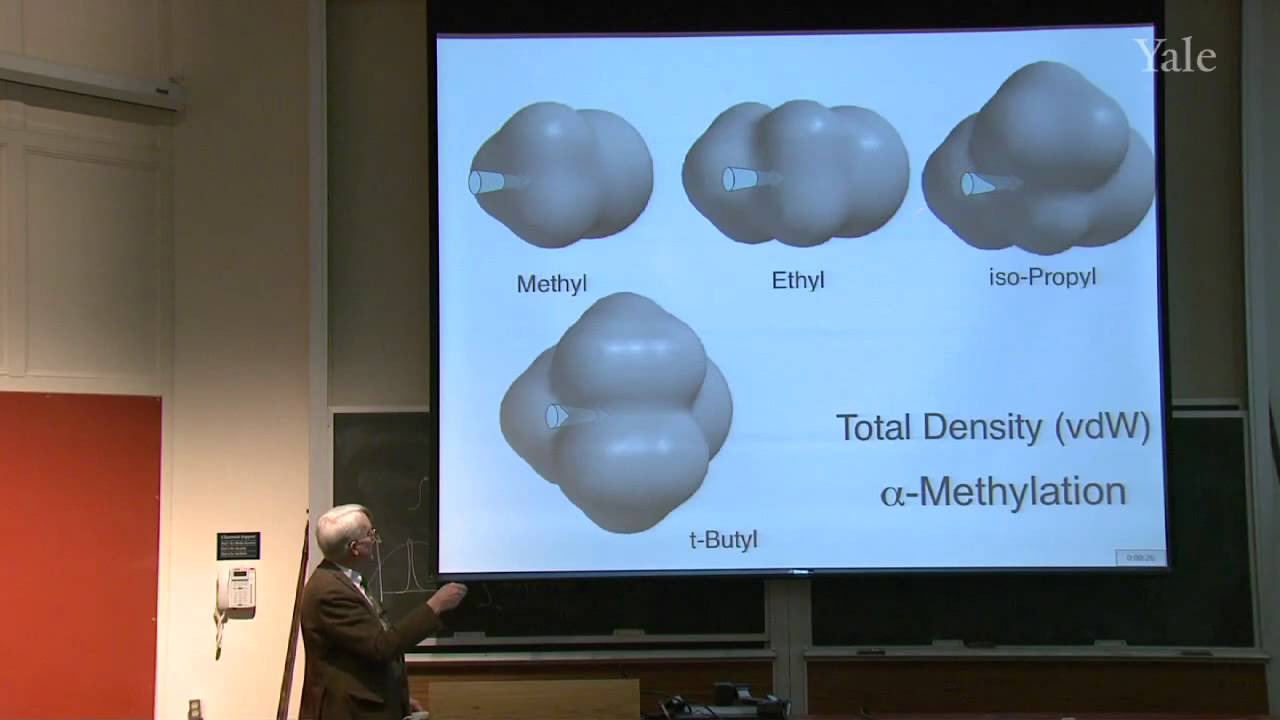
Michael McBride continues Yale's Freshman Organic Chemistry II with a lecture on how chemists established the mechanism of SN2 substitution by systematically ruling out competing pathways. He walks through five possible mechanisms, including two-step routes through pentavalent or trivalent carbon intermediates, and shows how stereochemistry, rate law, and substrate variation discriminate between them. Kenyon and Phillips' classic experiments demonstrating Walden inversion via backside attack get detailed treatment, alongside Bartlett and Knox's work confirming the same inversion. McBride covers second-order and pseudo-first-order kinetics, then examines how steric hindrance, ring strain, and changes in nucleophile or leaving group shift reaction rates. The lecture models mechanistic reasoning as a process of elimination rather than direct proof, grounded throughout in specific historical experiments rather than abstract description. Recorded in spring 2011 as part of the Open Yale Courses series.