LECTURES A GRATIS GLOBAL SERVICE
⌕ SEARCH GRATIS GLOBAL ↗
LECTURES
Addition to Form Three-Membered Rings: Carbenoids and Epoxidation
SOURCE: YOUTUBE · NO TRACKING UNTIL YOU PRESS PLAY · TROUBLE PLAYING? WATCH AT THE SOURCE ↗

Addition to Form Three-Membered Rings: Carbenoids and Epoxidation

51 MIN · EN · STATUS: [ STREAMING ]
RATE THIS
YALE · Freshman Organic Chemistry II with Michael McBride · LECTURE 13

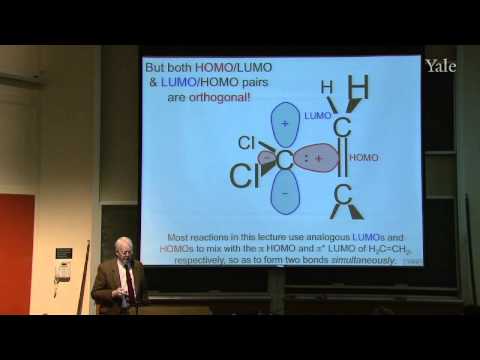
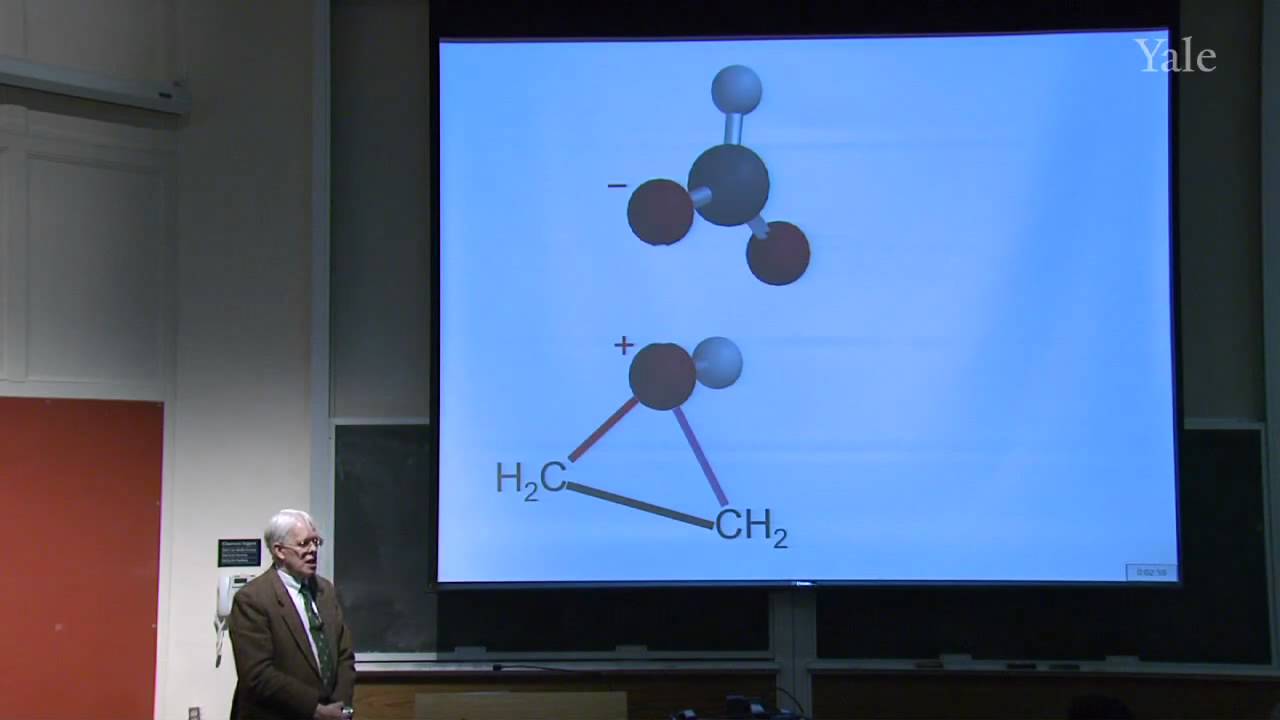
Michael McBride continues Yale's Freshman Organic Chemistry II with a lecture on reactions that build three-membered rings from alkenes. After finishing a drill on the pinacol rearrangement mechanism, he uses molecular-orbital analysis to explain simultaneous electrophilic and nucleophilic attack by a single atom on a double bond. He presents two competing mechanisms for cyclopropane formation via the Simmons-Smith alkylzinc carbenoid reagent, showing why theory favors a concerted one-step pathway over a stepwise one. The lecture then turns to epoxidation of alkenes by peroxycarboxylic acids, arguing this too proceeds through a single concerted transition state rather than discrete steps. McBride closes by comparing the stereochemistry and industrial scale of different routes to epoxides, connecting the mechanistic analysis to their commercial importance. Throughout, curved-arrow notation is used consistently to track electron-pair shifts across each proposed mechanism.
More from this course

12 LECTURES
Mechanism: How Energies and Kinetic Order Influence Reaction Rates

Mechanism: How Energies and Kinetic Order Influence Reaction Rates

YALE · 49 MIN
Peculiar Rate Laws, Bond Dissociation Energies, and Relative Reactivities

Peculiar Rate Laws, Bond Dissociation Energies, and Relative Reactivities

YALE · 48 MIN
Rate and Selectivity in Radical-Chain Reactions

Rate and Selectivity in Radical-Chain Reactions

YALE · 47 MIN
Electronegativity, Bond Strength, Electrostatics, and Non-Bonded Interactions

Electronegativity, Bond Strength, Electrostatics, and Non-Bonded Interactions

YALE · 50 MIN
Solvation, H-Bonding, and Ionophores

Solvation, H-Bonding, and Ionophores

YALE · 47 MIN
Brønsted Acidity and the Generality of Nucleophilic Substitution

Brønsted Acidity and the Generality of Nucleophilic Substitution

YALE · 47 MIN
Nucleophilic Substitution Tools: Stereochemistry, Rate Law, Substrate, Nucleophile

Nucleophilic Substitution Tools: Stereochemistry, Rate Law, Substrate, Nucleophile

YALE · 52 MIN
Solvent, Leaving Group, Bridgehead Substitution, and Pentavalent Carbon

Solvent, Leaving Group, Bridgehead Substitution, and Pentavalent Carbon

YALE · 48 MIN
Pentavalent Carbon? E2, SN1, E1

Pentavalent Carbon? E2, SN1, E1

YALE · 48 MIN
Cation Intermediates. Alkenes: Formation, Addition, and Stability

Cation Intermediates. Alkenes: Formation, Addition, and Stability

YALE · 51 MIN
Carbocations and the Mechanism of Electrophilic Addition to Alkenes and Alkynes

Carbocations and the Mechanism of Electrophilic Addition to Alkenes and Alkynes

YALE · 52 MIN
Nucleophilic Participation During Electrophilic Addition to Alkenes

Nucleophilic Participation During Electrophilic Addition to Alkenes

YALE · 49 MIN