Alkynes: Conjugation in Allylic Intermediates and Dienes
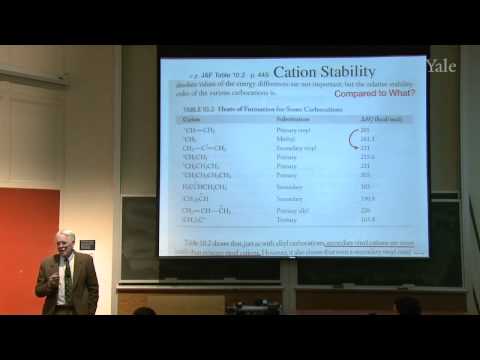
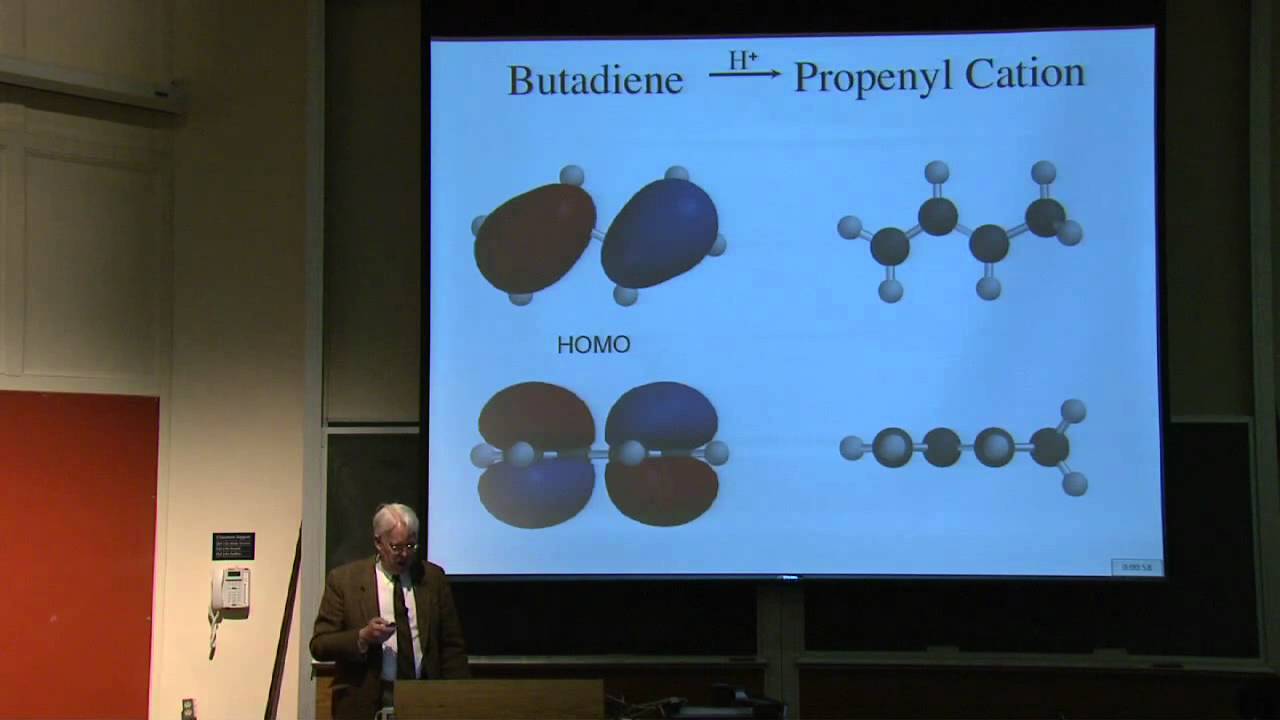
Michael McBride continues Yale's Freshman Organic Chemistry II (CHEM 125B) with a lecture on alkynes and conjugated systems. He opens with addition reactions to acetylenes, covering regio- and stereochemistry, then shows how strong base can isomerize an internal alkyne to its less stable terminal form, exploiting the unusual acidity of terminal acetylenic hydrogens. The core of the lecture asks when conjugation actually matters, working through allylic cations, anions, radicals, and transition states to show that allylic conjugation is worth roughly 13 kcal per mole. McBride uses the regiochemistry of DCl addition to 1,3-pentadiene to demonstrate rapid collapse of an allylic ion pair, and explains how NBS controls bromine concentration to favor allylic substitution over direct addition. He closes by contrasting this with diene conjugation, which turns out to be a much smaller stabilizing effect. Recorded in spring 2011 as part of the Open Yale Courses series.