Aromatic Transition States: Cycloaddition and Electrocyclic Reactions
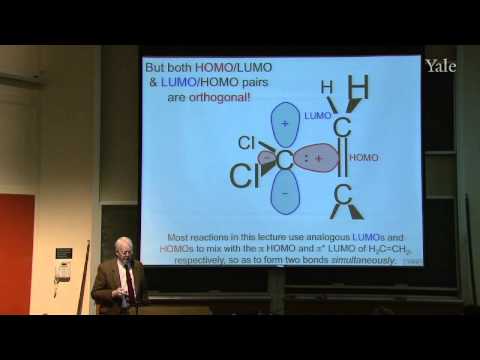
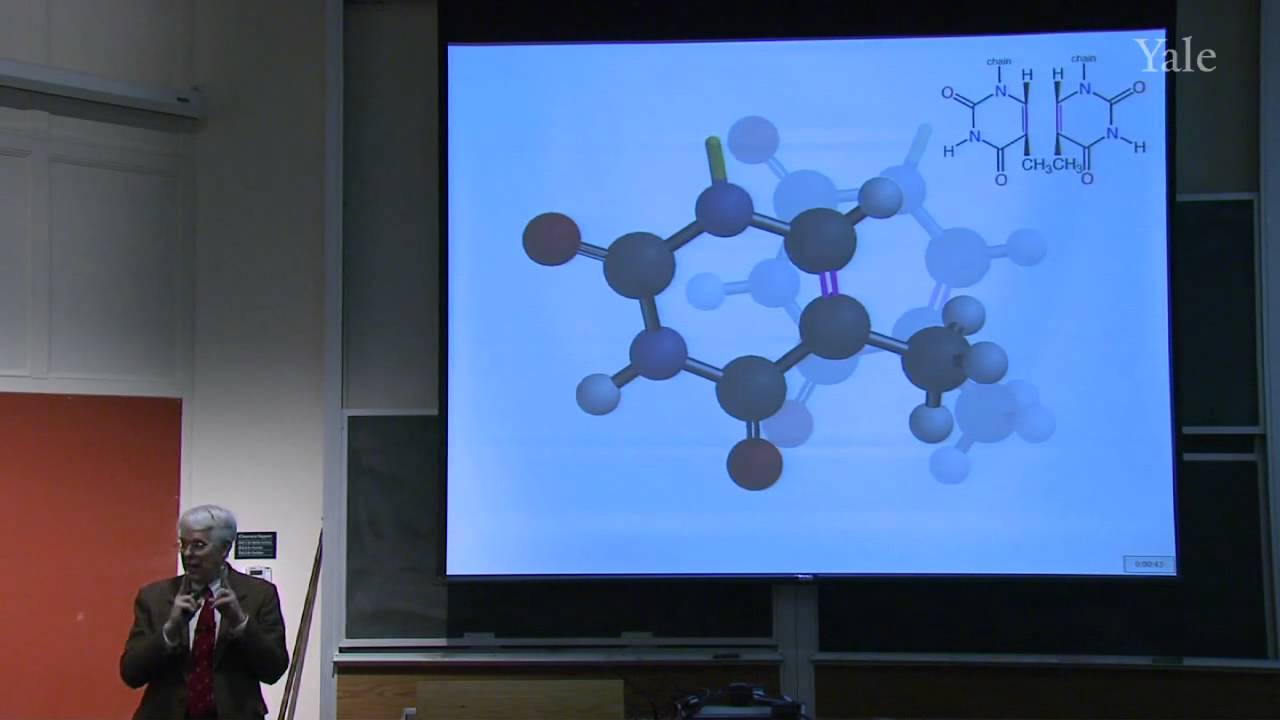
Michael McBride continues Yale's Freshman Organic Chemistry II with a lecture on pericyclic reactions, showing how cyclic conjugation of p-orbitals governs transition states the way aromaticity governs stable molecules. He works through the six-electron Diels-Alder cycloaddition, using regiochemistry, stereochemistry, and kinetics to demonstrate that both sigma bonds form simultaneously though not always symmetrically. He contrasts the thermally forbidden dimerization of thymine residues in DNA with the four-electron cycloaddition that photochemistry allows, then turns to electrocyclic ring opening and closing, explaining the conrotatory Mobius and disrotatory Huckel pathways and how light changes which one operates. The lecture closes with Dewar benzene, an unstable molecule that can be produced photochemically and survives because its ring-opening transition state has unfavorable orbital overlap. Chapters cover aromatic ions, pericyclic reactions, electrocyclic stereochemistry, and the Dewar benzene case, recorded at Yale in spring 2011.