LECTURES A GRATIS GLOBAL SERVICE
⌕ SEARCH GRATIS GLOBAL ↗
LECTURES
Diamagnetic Anisotropy and Spin-Spin Splitting
SOURCE: YOUTUBE · NO TRACKING UNTIL YOU PRESS PLAY · TROUBLE PLAYING? WATCH AT THE SOURCE ↗

Diamagnetic Anisotropy and Spin-Spin Splitting

48 MIN · EN · STATUS: [ STREAMING ]
RATE THIS
YALE · Freshman Organic Chemistry II with Michael McBride · LECTURE 23

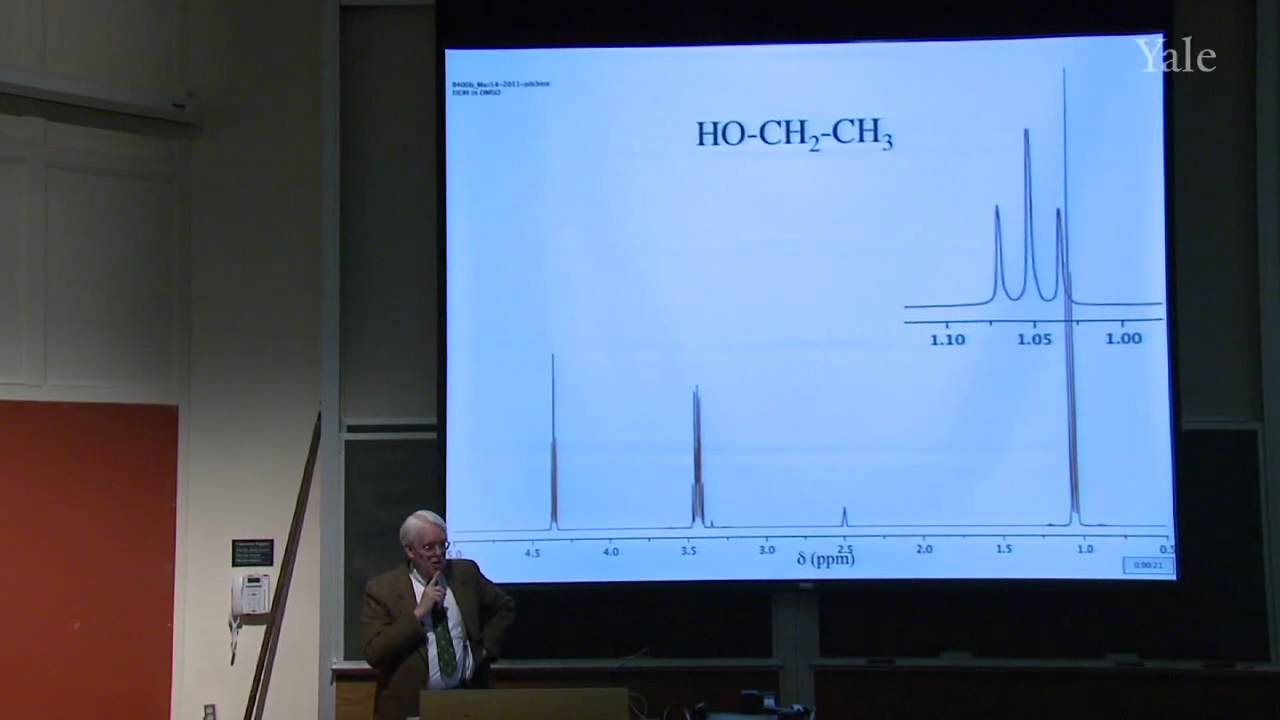
Michael McBride continues Yale's Freshman Organic Chemistry II with a lecture on NMR spectroscopy, covering why chemical shift and spin-spin splitting arise from different physical causes. He explains how through-space magnetic interactions average to zero during molecular tumbling, and how diamagnetic anisotropy accounts for the unusual chemical shifts seen in acetylene and in aromatic and antiaromatic compounds. The lecture then turns to spin-spin splitting, showing how multiplicity reveals nearby magnetic nuclei and why coupling constant J, measured in Hz rather than fractional units, depends only on molecular structure. McBride works through why J depends on orbital overlap rather than spatial proximity, noting the counterintuitive result that anti conformations give larger coupling than eclipsed ones. The talk is organized in three chapters, moving from anisotropy and aromaticity through splitting multiplicity to the orbital basis of J, and runs about 48 minutes with chalkboard derivations throughout.
More from this course

12 LECTURES
Mechanism: How Energies and Kinetic Order Influence Reaction Rates

Mechanism: How Energies and Kinetic Order Influence Reaction Rates

YALE · 49 MIN
Peculiar Rate Laws, Bond Dissociation Energies, and Relative Reactivities

Peculiar Rate Laws, Bond Dissociation Energies, and Relative Reactivities

YALE · 48 MIN
Rate and Selectivity in Radical-Chain Reactions

Rate and Selectivity in Radical-Chain Reactions

YALE · 47 MIN
Electronegativity, Bond Strength, Electrostatics, and Non-Bonded Interactions

Electronegativity, Bond Strength, Electrostatics, and Non-Bonded Interactions

YALE · 50 MIN
Solvation, H-Bonding, and Ionophores

Solvation, H-Bonding, and Ionophores

YALE · 47 MIN
Brønsted Acidity and the Generality of Nucleophilic Substitution

Brønsted Acidity and the Generality of Nucleophilic Substitution

YALE · 47 MIN
Nucleophilic Substitution Tools: Stereochemistry, Rate Law, Substrate, Nucleophile

Nucleophilic Substitution Tools: Stereochemistry, Rate Law, Substrate, Nucleophile

YALE · 52 MIN
Solvent, Leaving Group, Bridgehead Substitution, and Pentavalent Carbon

Solvent, Leaving Group, Bridgehead Substitution, and Pentavalent Carbon

YALE · 48 MIN
Pentavalent Carbon? E2, SN1, E1

Pentavalent Carbon? E2, SN1, E1

YALE · 48 MIN
Cation Intermediates. Alkenes: Formation, Addition, and Stability

Cation Intermediates. Alkenes: Formation, Addition, and Stability

YALE · 51 MIN
Carbocations and the Mechanism of Electrophilic Addition to Alkenes and Alkynes

Carbocations and the Mechanism of Electrophilic Addition to Alkenes and Alkynes

YALE · 52 MIN
Nucleophilic Participation During Electrophilic Addition to Alkenes

Nucleophilic Participation During Electrophilic Addition to Alkenes

YALE · 49 MIN