Higher-Order Effects, Dynamics, and the NMR Time Scale
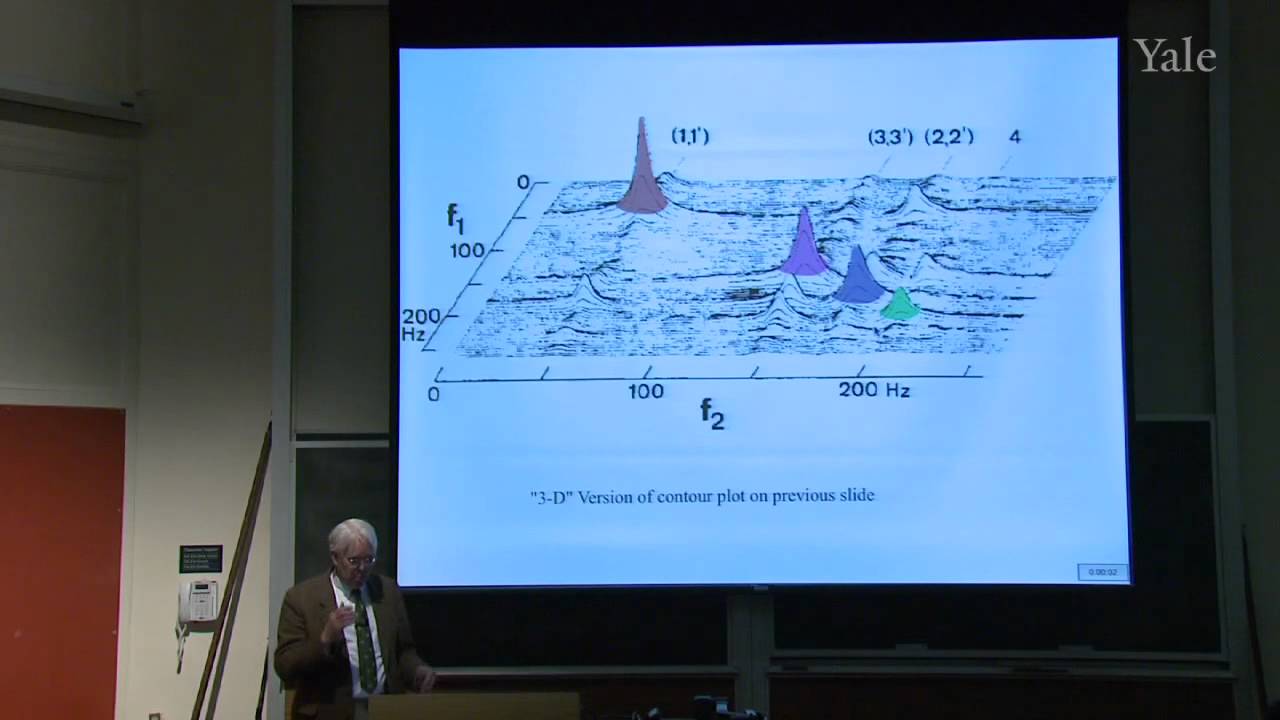
Michael McBride continues Yale's Freshman Organic Chemistry II with a lecture on the finer points of NMR spectroscopy. He explains why C-13 splitting depends on orbital hybridization, then works through higher-order effects, showing why methane gives a simple singlet despite its many protons, as mixing of wave functions with similar energy complicates multiplets for nuclei with close chemical shifts. He turns to how averaging of chemical shifts or spin-spin splitting can measure the rate of fast structural changes, such as conformational shifts or hydrogen bonding, and why NMR's frequency-dependent time scale makes such averaging easier to observe than in infrared spectroscopy. A worked problem predicts the spectrum of a compound with diastereotopic groups, and the lecture closes with proton decoupling and a brief turn to electrophile activation in Friedel-Crafts reactions. Recorded in Spring 2011 as part of Yale's CHEM 125B.