Imines and Enamines. Oxidation and Reduction
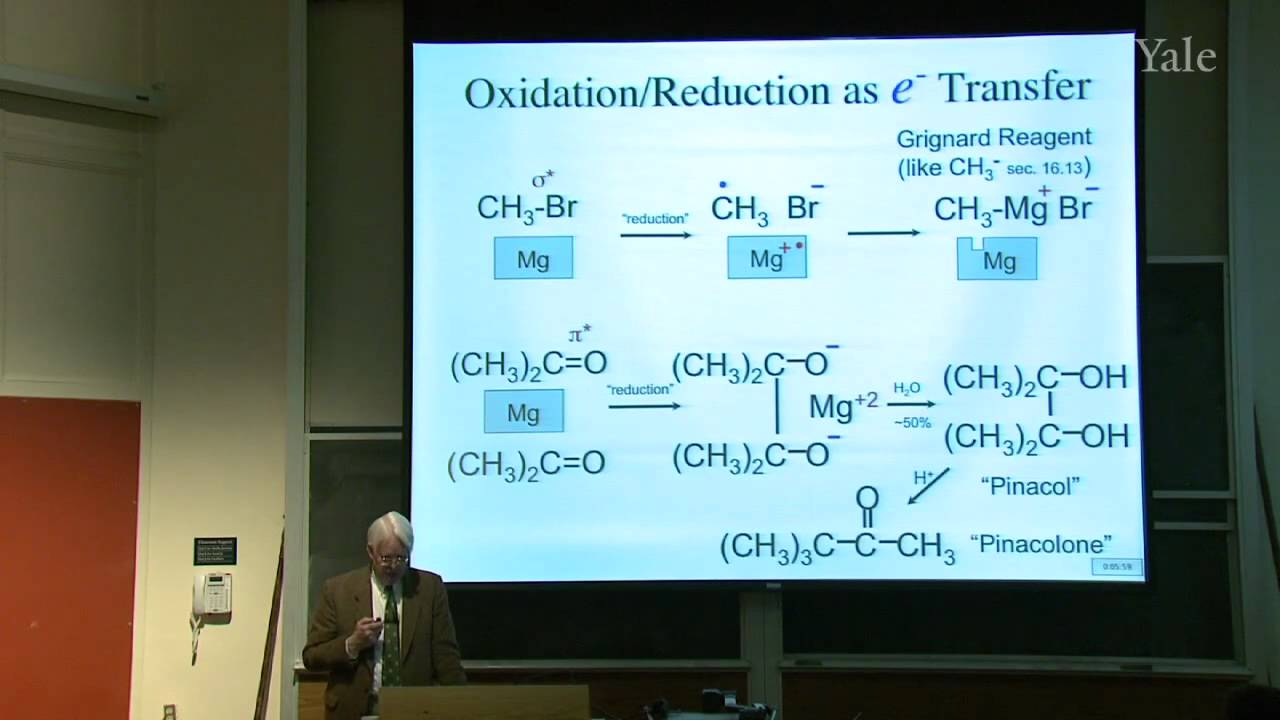
Michael McBride continues Yale's Freshman Organic Chemistry II with a lecture on imines, enamines, and the concept of oxidation states. He covers the Strecker synthesis of amino acids alongside the biological equivalent carried out by L-glutamate dehydrogenase and by transamination, then turns to Stork's enamine method for alkylating and acylating ketones. The second half separates two meanings of oxidation and reduction: real electron transfer, as seen in Grignard reagent formation and the pinacol reduction, versus the bookkeeping convention chemists use to assign oxidation states by treating covalent bonds as if they were ionic. McBride works through each idea at the board, building from mechanism to the practical question of how oxidation-state assignments guide reagent choice even when no electrons actually change hands. Recorded in Spring 2011 as lecture 29 of the course, with chapter markers separating imines, amino acid synthesis, enamine chemistry, and the two oxidation-reduction frameworks.