Linear and Cyclic Conjugation Theory: 4n+2 Aromaticity
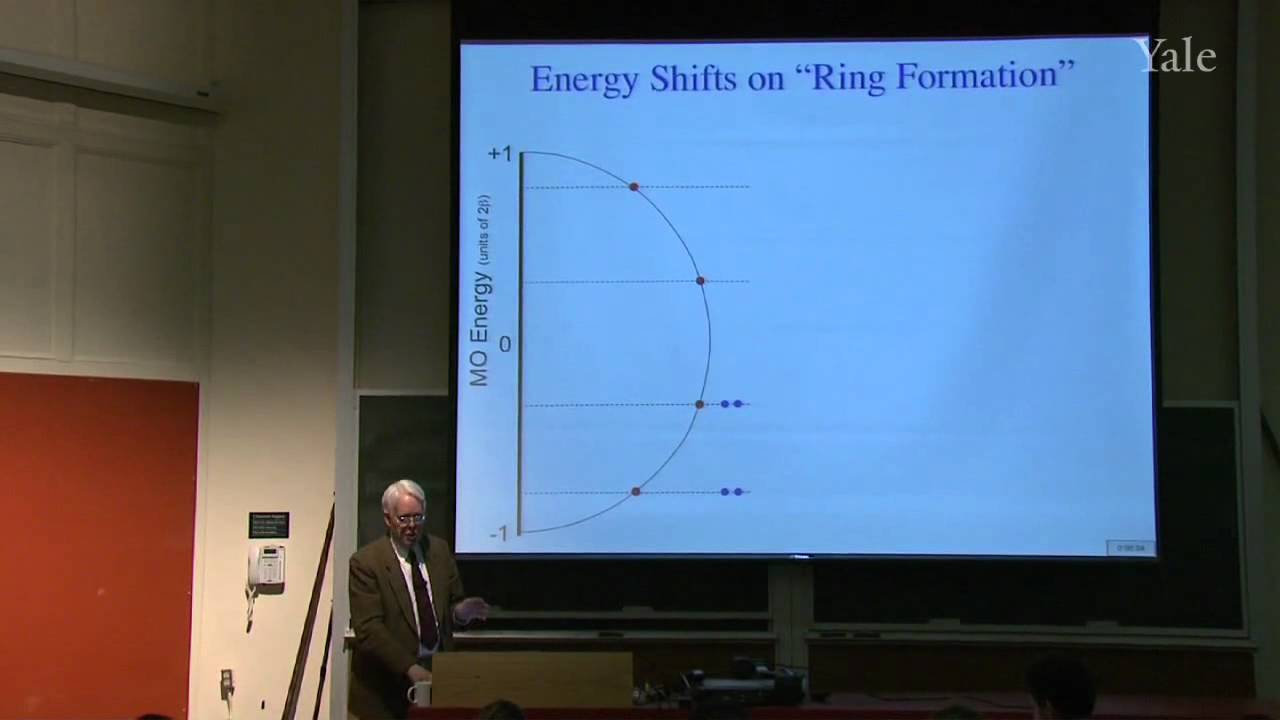
Michael McBride's Freshman Organic Chemistry II lecture at Yale (CHEM 125B) explains why conjugation stabilizes molecules and why aromatic rings gain so much more stabilization than open chains. He opens with linear conjugation, showing that despite large shifts in individual orbital energies, the overall pi-electron energy of a diene changes little, and introduces a semicircle mnemonic for predicting conjugation energy in polyenes and allylic systems. He then turns to benzene and Huckel's 4n+2 rule, deriving a circle mnemonic that shows how closing a conjugated chain into a ring alternately stabilizes and destabilizes successive orbitals. The final segment generalizes the aromaticity concept to heteroaromatic molecules like furan and imidazole, polycyclic compounds like naphthalene, and ions such as cyclopentadienide. Recorded in Spring 2011 as part of Yale's Open Yale Courses series.