Medical MRI and Chemical NMR
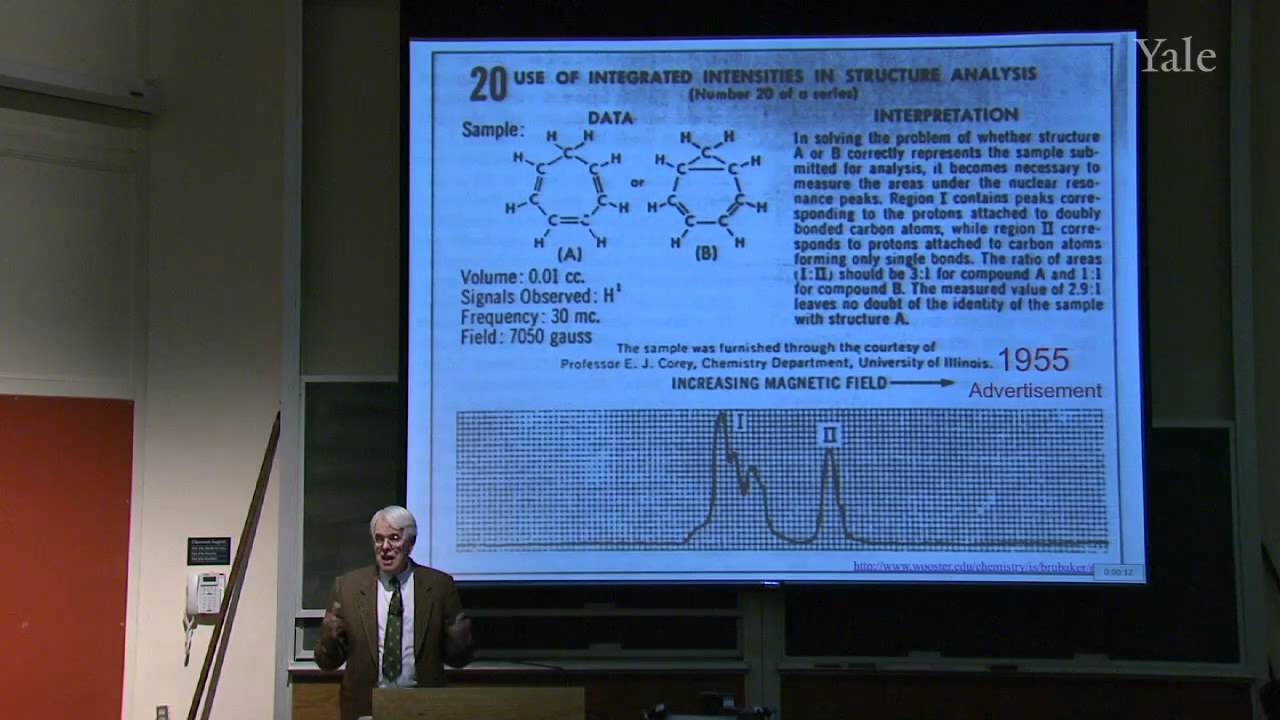
Michael McBride's Freshman Organic Chemistry II lecture at Yale explains how magnetic resonance imaging and chemical NMR spectroscopy share a physical basis but differ in application. He opens with tomography, showing how field gradients let MRI machines localize water in the body and reconstruct three-dimensional images, then covers how relaxation-dependent signal intensity enables BOLD functional MRI to detect brain activity. The lecture shifts to chemical NMR, tracing its development as a technique requiring a highly uniform magnetic field rather than gradients. McBride demonstrates how peak integrals reveal the relative number of protons in different molecular environments and how chemical shifts, measured as downfield or upfield displacement, indicate the local bonding and electron density around proton groups. The talk is organized into four chapters covering tomography, NMR's history, proton counting by integration, and the origins of chemical shift, giving students a working link between the medical imaging technology and the laboratory spectroscopy tool.