Oxidation States and Mechanisms
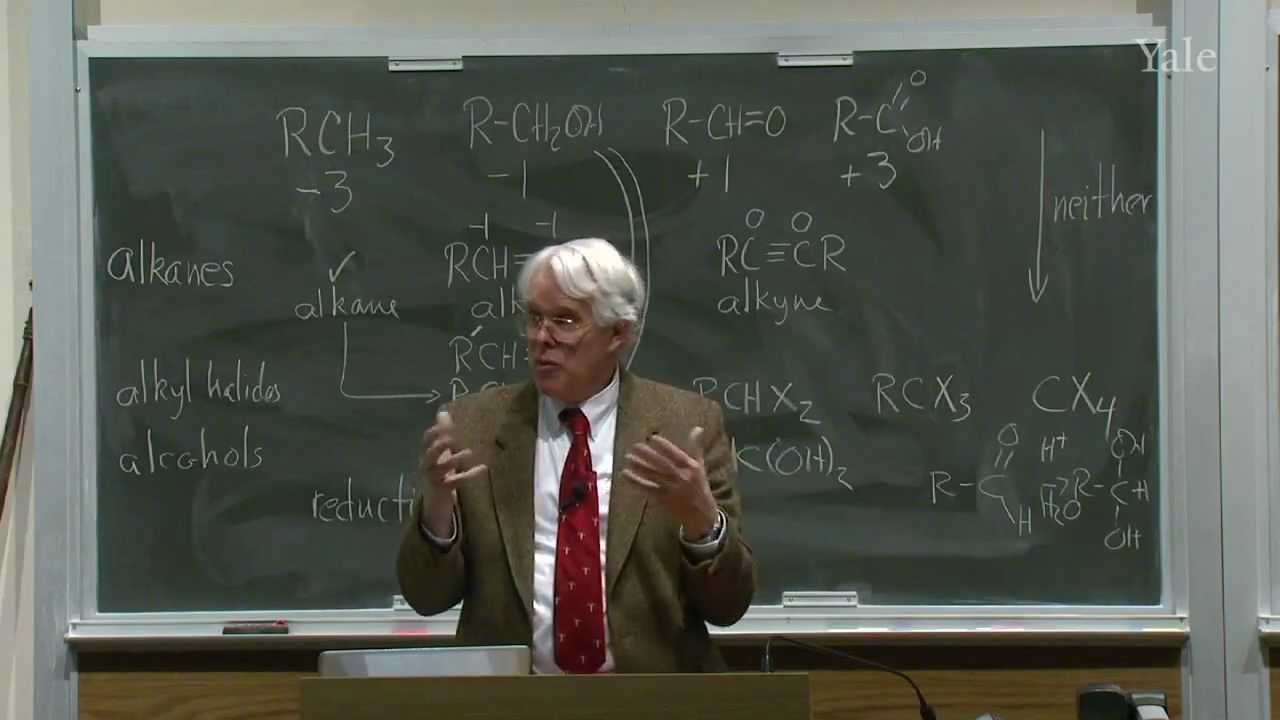
Michael McBride continues Yale's Freshman Organic Chemistry II with a lecture on oxidation states and reaction mechanisms. He opens with an exam question on how visible and NMR spectroscopy led to a long-standing misassignment of the triphenylmethyl dimer's structure, then reviews 1970 evidence showing that Friedel-Crafts propylation proceeds through an SN2 mechanism rather than a protonated cyclopropane intermediate. The core of the lecture assigns oxidation states from -4 to +4 to carbon atoms in starting materials and products, using this framework to judge whether a given reagent is oxidizing, reducing, or neither. McBride then works through alcohol oxidation by elemental bromine and by Cr(VI) reagents, tracing the substitution, elimination, and addition steps involved, and shows how adjusting reaction conditions can make oxidation more selective. The lecture is chaptered into five segments covering these topics in sequence.