LECTURES A GRATIS GLOBAL SERVICE
⌕ SEARCH GRATIS GLOBAL ↗
LECTURES
Triphenylmethyl and an Introduction to Carbonyl Chemistry
SOURCE: YOUTUBE · NO TRACKING UNTIL YOU PRESS PLAY · TROUBLE PLAYING? WATCH AT THE SOURCE ↗

Triphenylmethyl and an Introduction to Carbonyl Chemistry

46 MIN · EN · STATUS: [ STREAMING ]
RATE THIS
YALE · Freshman Organic Chemistry II with Michael McBride · LECTURE 27

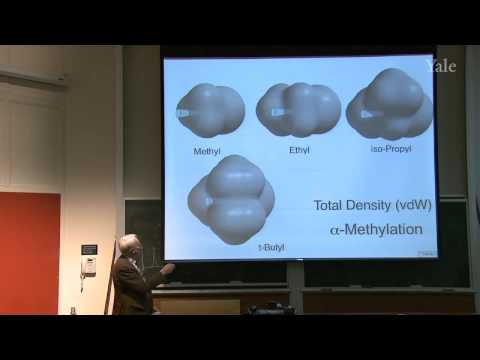
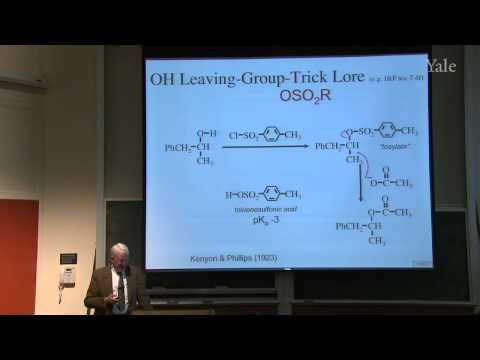
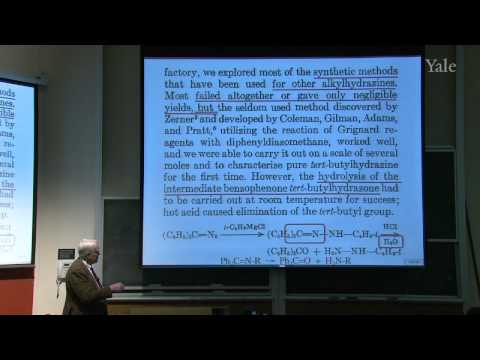
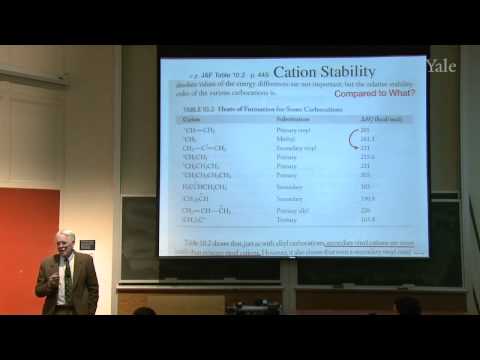
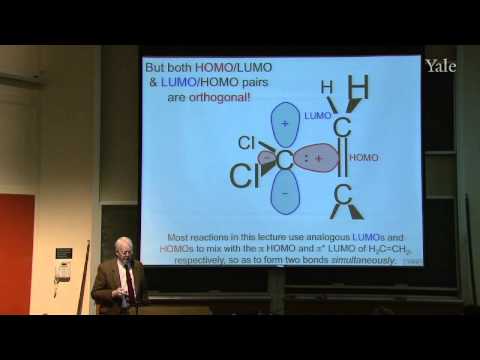
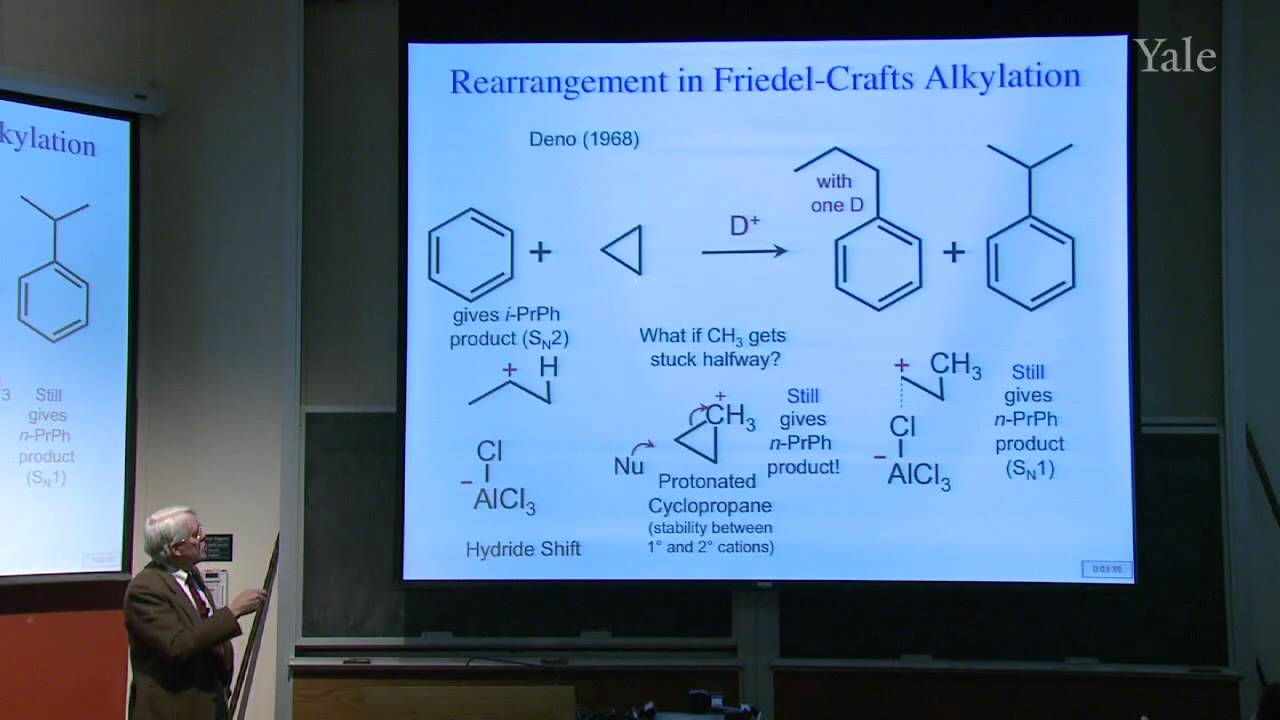
Yale's Freshman Organic Chemistry II (CHEM 125B), taught by Michael McBride, opens with Moses Gomberg's studies of hexaphenylethane and his claim to have made the first trivalent carbon compound, the triphenylmethyl radical, framed as the moment fundamental organic chemistry took root in America. McBride then turns to whether protonated cyclopropane intermediates explain rearrangements in Friedel-Crafts alkylation, using isotopic labeling evidence to test the idea. The lecture moves into carbonyl chemistry, showing how C-13 NMR chemical shifts of aldehydes and ketones were established empirically, and distinguishing the carbonyl group's thermodynamic stability from its kinetic reactivity. He covers acid- and base-catalyzed reactions that proceed through enol or enolate intermediates, the four reaction patterns of carboxylic acids, and the multistep mechanism of acid-catalyzed acetal hydrolysis. Recorded in 2011 as part of the Open Yale Courses series.
More from this course

12 LECTURES
Mechanism: How Energies and Kinetic Order Influence Reaction Rates

Mechanism: How Energies and Kinetic Order Influence Reaction Rates

YALE · 49 MIN
Peculiar Rate Laws, Bond Dissociation Energies, and Relative Reactivities

Peculiar Rate Laws, Bond Dissociation Energies, and Relative Reactivities

YALE · 48 MIN
Rate and Selectivity in Radical-Chain Reactions

Rate and Selectivity in Radical-Chain Reactions

YALE · 47 MIN
Electronegativity, Bond Strength, Electrostatics, and Non-Bonded Interactions

Electronegativity, Bond Strength, Electrostatics, and Non-Bonded Interactions

YALE · 50 MIN
Solvation, H-Bonding, and Ionophores

Solvation, H-Bonding, and Ionophores

YALE · 47 MIN
Brønsted Acidity and the Generality of Nucleophilic Substitution

Brønsted Acidity and the Generality of Nucleophilic Substitution

YALE · 47 MIN
Nucleophilic Substitution Tools: Stereochemistry, Rate Law, Substrate, Nucleophile

Nucleophilic Substitution Tools: Stereochemistry, Rate Law, Substrate, Nucleophile

YALE · 52 MIN
Solvent, Leaving Group, Bridgehead Substitution, and Pentavalent Carbon

Solvent, Leaving Group, Bridgehead Substitution, and Pentavalent Carbon

YALE · 48 MIN
Pentavalent Carbon? E2, SN1, E1

Pentavalent Carbon? E2, SN1, E1

YALE · 48 MIN
Cation Intermediates. Alkenes: Formation, Addition, and Stability

Cation Intermediates. Alkenes: Formation, Addition, and Stability

YALE · 51 MIN
Carbocations and the Mechanism of Electrophilic Addition to Alkenes and Alkynes

Carbocations and the Mechanism of Electrophilic Addition to Alkenes and Alkynes

YALE · 52 MIN
Nucleophilic Participation During Electrophilic Addition to Alkenes

Nucleophilic Participation During Electrophilic Addition to Alkenes

YALE · 49 MIN