Chemical Reactivity: SOMO, HOMO, and LUMO
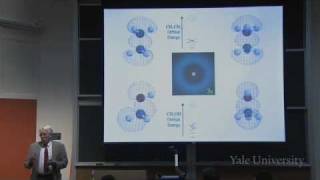
Yale's Freshman Organic Chemistry course (CHEM 125), taught by Professor J. Michael McBride, turns to the molecular orbital picture of reactivity. McBride opens with BH3 and earlier examples of what he calls pathological bonding, comparing how chemists use localized bonds, vacant atomic orbitals, and unshared pairs against views grounded in total electron density or computed molecular orbitals. He then develops reactivity through the overlap of singly occupied molecular orbitals, and more commonly a high-energy highest occupied molecular orbital meeting a low-energy lowest unoccupied molecular orbital, showing this HOMO-LUMO framework as a generalization of the classic acid-base concept. The lecture closes by laying out criteria for assessing reactivity. Chapters move from BH3's bonding, through electron density and orbital views, into the HOMO-LUMO analysis and reactivity criteria, giving a full fifty-minute treatment suited to students already familiar with basic orbital theory.