Recognizing Functional Groups
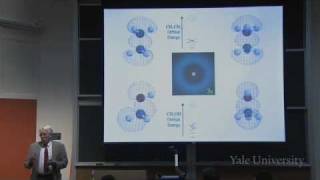
Yale chemist J. Michael McBride continues his Freshman Organic Chemistry course (CHEM 125) with a lecture on the HOMO/LUMO model of chemical reactivity, focusing on how to recognize when a HOMO is unusually high in energy (making a molecule basic) or a LUMO unusually low (making it acidic). He works through BH3, which acts as both acid and base and dimerizes through unusual three-center Y bonds, then analyzes why both HF and CH3F have low LUMOs, distinguishing molecular orbital nodes that come from atomic orbital nodes from those that are antibonding. The lecture closes by showing how HF reacting with hydroxide involves simultaneous bond-making and bond-breaking. Recorded in Fall 2008, the talk is organized into four chapters moving from general orbital theory to specific molecular comparisons, aimed at students already familiar with molecular orbital basics.