LECTURES A GRATIS GLOBAL SERVICE
⌕ SEARCH GRATIS GLOBAL ↗
LECTURES
Potential Energy Surfaces, Transition State Theory and Reaction Mechanism
SOURCE: YOUTUBE · NO TRACKING UNTIL YOU PRESS PLAY · TROUBLE PLAYING? WATCH AT THE SOURCE ↗

Potential Energy Surfaces, Transition State Theory and Reaction Mechanism

48 MIN · EN · STATUS: [ STREAMING ]
RATE THIS
YALE · Freshman Organic Chemistry with J. Michael McBride · LECTURE 37

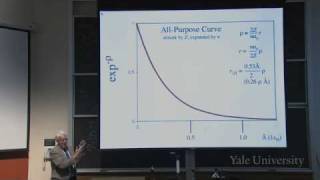
J. Michael McBride closes out Yale's Freshman Organic Chemistry course with a lecture on reaction rates. He starts from the statistical basis of the law of mass action, derived from the Boltzmann factor and entropy, then builds toward potential energy surfaces that map energy against molecular geometry. McBride shows how this surface can be worked out exactly for a linear triatomic system, but argues it is more practical to track collective energies of starting material, transition state, and product using Eyring theory to predict reaction rates. Free-radical chain halogenation serves as the worked example, with bond dissociation energies used to predict both equilibria and rates. The lecture ends with a review of the semester's material from a physical-organic chemistry perspective, tying together the course's recurring themes. Recorded in Fall 2008 as lecture 37 of the series.

At a glance

Lecture facts

Runtime compared with the other 151 Chemistry lectures
Runtime48 m
Compared with ChemistryShorter than 83%
This series

Freshman Organic Chemistry with J. Michael McBride

Every lecture in order, sized by its length.

  • Earlier lectures
  • This lecture
  • Still to come
Lecture 37 of 3729 h 17 m before this · 30 h 5 m in total

More from this course

12 LECTURES
How Do You Know?

How Do You Know?

YALE · 47 MIN
Force Laws, Lewis Structures and Resonance

Force Laws, Lewis Structures and Resonance

YALE · 50 MIN
Double Minima, Earnshaw's Theorem and Plum-Puddings

Double Minima, Earnshaw's Theorem and Plum-Puddings

YALE · 45 MIN
Coping with Smallness and Scanning Probe Microscopy

Coping with Smallness and Scanning Probe Microscopy

YALE · 50 MIN
X-Ray Diffraction

X-Ray Diffraction

YALE · 47 MIN
Seeing Bonds by Electron Difference Density

Seeing Bonds by Electron Difference Density

YALE · 51 MIN
Quantum Mechanical Kinetic Energy

Quantum Mechanical Kinetic Energy

YALE · 49 MIN
One-Dimensional Wave Functions

One-Dimensional Wave Functions

YALE · 50 MIN
Chladni Figures and One-Electron Atoms

Chladni Figures and One-Electron Atoms

YALE · 50 MIN
Reality and the Orbital Approximation

Reality and the Orbital Approximation

YALE · 49 MIN
Orbital Correction and Plum-Pudding Molecules

Orbital Correction and Plum-Pudding Molecules

YALE · 49 MIN
Overlap and Atom-Pair Bonds

Overlap and Atom-Pair Bonds

YALE · 51 MIN