Orbital Correction and Plum-Pudding Molecules
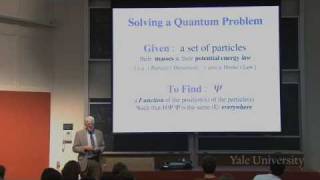
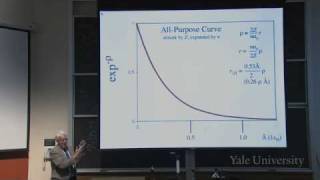
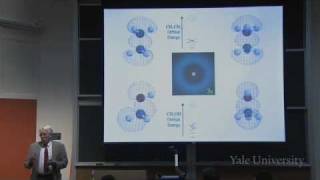
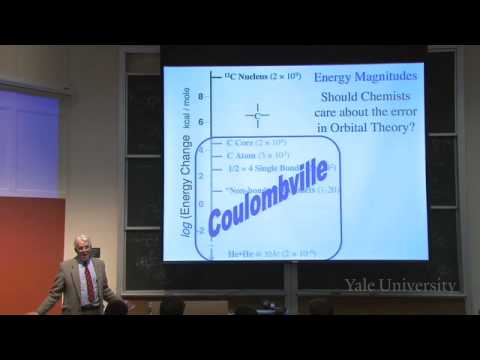
Yale professor J. Michael McBride continues his Freshman Organic Chemistry course with a lecture on correcting orbital theory for electron repulsion. He introduces the Z-effective and Self Consistent Field methods used to approximate this correction, and explains how the residual error gets labeled correlation energy, a term that disguises rather than solves the underlying problem. McBride then extends J.J. Thomson's Plum-Pudding model of the atom to molecules, showing the close formal analogy between the molecular orbitals of methane and ammonia and the atomic orbitals of neon, which shares their proton and neutron count. He demonstrates how pulling protons out of the neon nucleus to act as hydrogen atoms distorts the underlying kinetic-energy shape into the orbitals seen in these molecules. Recorded in Fall 2008, the lecture is chaptered into sections on electron repulsion correction, correlation energy, kinetic energy effects on orbital shape, and case studies with methane and ammonia.