Force Laws, Lewis Structures and Resonance
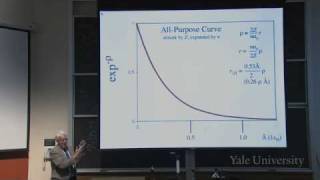
Yale professor J. Michael McBride opens this Freshman Organic Chemistry lecture by asking, in Newton's spirit, what force law actually governs chemical bonding. He shows why neither Hooke's Law (direct distance dependence) nor Coulomb's and gravity's inverse dependence can explain it, and why a composite function like the Morse potential is needed instead. From there he traces G. N. Lewis's cubic-octet theory, built on the newly discovered electron, into the shared-pair model of bonding, covering Lewis-dot notation and formal charge along the way. The lecture closes by showing where the Lewis formalism breaks down in single-minimum cases, and how chemists patched it with the concept of resonance. Recorded in Fall 2008 as the second lecture of Yale's CHEM 125, it is chalkboard-and-lecture format, moving from historical context to working chemical reasoning.