Valence Theory and Constitutional Structure (1858)
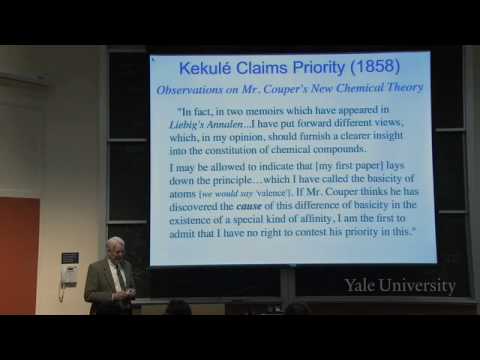
Yale's Freshman Organic Chemistry course (CHEM 125), taught by J. Michael McBride, traces how valence theory replaced the older radical and type theories of chemical structure. The lecture follows Archibald Couper and August Kekule as they develop the idea of atomic valence, including carbon's tetravalence and its ability to bond to itself, forming chains. McBride shows how this framework gave the first real explanation for isomerism and spurred the invention of modern chemical nomenclature and notation. The lecture closes with the history of three-dimensional molecular models, from early brass-strip constructions to croquet-ball assemblies, precursors to the models still used in classrooms today. Chapter markers divide the hour into Couper's contribution, carbon's self-linking property, Kekule's notational advances, and the physical modeling section, giving a clear historical account of how structural chemistry took its modern shape in the mid-1800s.