Coping with Smallness and Scanning Probe Microscopy
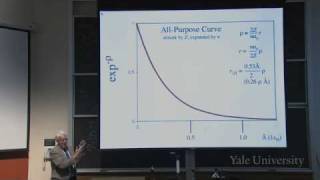
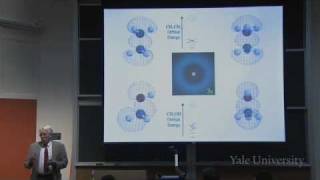
J. Michael McBride's fourth lecture in Yale's Freshman Organic Chemistry course asks whether chemists can actually see or feel chemical bonds, and what counts as proper scientific evidence for something too small to observe directly. He opens with early twentieth century clairvoyant charlatans who claimed to perceive atomic structure, then contrasts their claims with Newton's rings and Benjamin Franklin's oil-water experiment, both of which measured molecular scale distances using simple physical setups. The lecture moves on to modern Scanning Probe Microscopy, developed over the preceding twenty five years, which lets chemists feel out individual atoms and electron pairs, though not bonds themselves. It closes with resonance structures for isomers of hydrogen, carbon, nitrogen, and oxygen. Recorded in Fall 2008, the lecture mixes history of science with hands on measurement technique to question how confident chemists can be about the invisible structures they draw.