Oxygen and the Chemical Revolution (Beginning to 1789)
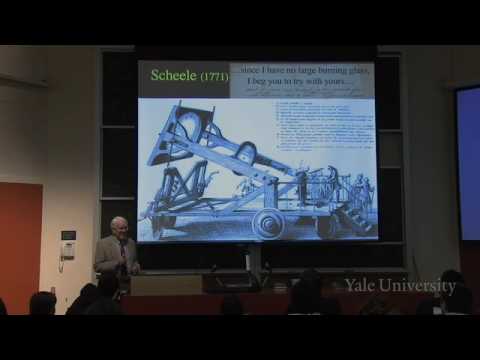
Yale professor J. Michael McBride opens a chronological history of organic chemistry with Lavoisier, the figure he calls the father of modern chemistry. The lecture traces chemistry's roots in alchemy and ancient technology before turning to Carl Scheele, the Swedish apothecary who discovered oxygen and first prepared pure organic acids. McBride then works through Lavoisier's Traite Elementaire de Chimie, showing how weighing gases, measuring heat with a calorimeter, and insisting on precise language reshaped the field. Central ideas covered include conservation of mass for the elements and oxidation, the process by which reaction with oxygen could turn a base or radical into an acid. The talk closes with Lavoisier's new nomenclature for elements, calories, and radicals. Delivered as lecture nineteen of Yale's Freshman Organic Chemistry course, recorded in Fall 2008, it is organized into five chapters moving from alchemists through Scheele to the Chemical Revolution itself.