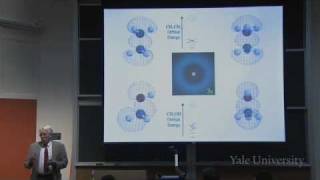
Preparing Single Enantiomers and the Mechanism of Optical Rotation
Yale's Freshman Organic Chemistry course (CHEM 125), taught by J. Michael McBride, turns this session over to guest lecturer Laurence Barron of the University of Glasgow. Barron covers biological resolution and the synthesis of single enantiomers before focusing on how chiral molecules rotate polarized light. He opens with a sketch of Lord Kelvin's work on chirality, then explains natural and magnetic optical rotation and walks through the carbonyl chromophore as a worked example of optical activity. The lecture gets into the physics of mixing wave functions through coordinated electric and magnetic fields, showing why predicting net optical rotation is rarely straightforward even though the underlying mechanism is understood. It closes by connecting the topic to practical stakes, discussing chiral switches in drugs and their relevance to pharmacology, using omeprazole as a case study in naming and three-dimensional visualization of a single-enantiomer drug.