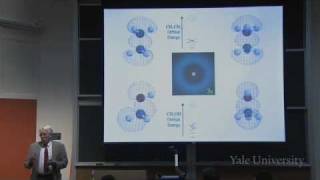
Determining Chemical Structure by Isomer Counting (1869)
J. Michael McBride's Freshman Organic Chemistry course at Yale turns to the problem of assigning molecular structure before direct experimental observation was possible. The lecture opens with how Kekule justified benzene's hexagonal ring, then spends most of its time on Wilhelm Koerner, a chemist working in Palermo who built a rigorous system of isomer counting and chemical transformation to prove structural claims rather than guess at them. McBride walks through Koerner's assumptions about replacement and experimental distinguishability before reaching the centerpiece: Koerner's proof that all six hydrogen positions on benzene are chemically equivalent. The lecture frames this as a triumph of logical inference largely ignored in its time because Koerner worked far from the era's chemical power centers. Chapter markers divide the hour into Kekule's reasoning, Koerner's method, his assumptions, and the equivalence proof itself.