Seeing Bonds by Electron Difference Density
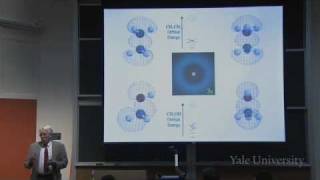
Yale's Freshman Organic Chemistry course continues with J. Michael McBride explaining X-ray crystallography and what diffraction patterns in reciprocal space reveal about electron distribution in molecules and crystal lattices. He uses a hexagonal benzene pattern and Rosalind Franklin's X-ray image of DNA to show how even and offset planes produce the double helix's diffraction signature. McBride then turns to electron difference density mapping, demonstrating how it reveals chemical bonds and unshared electron pairs along with their shapes, noting they appear only one-twentieth as dense as classical Lewis pair models predict. An anomalous density reading in the carbon-fluorine bond leads into the course's recurring question, compared to what. Recorded in fall 2008, the lecture runs just under an hour and is organized into four chapters covering diffraction theory, DNA structure, bond visualization, and the comparative framework McBride uses throughout the course.