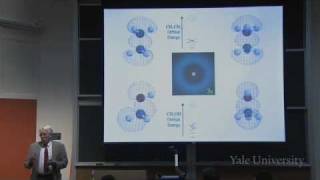
Van't Hoff's Tetrahedral Carbon and Chirality
Yale chemist J. Michael McBride continues his Freshman Organic Chemistry course with a lecture on van't Hoff's tetrahedral carbon model and the origins of stereochemistry. McBride explains how van't Hoff used tetrahedral geometry to account for known optical isomers with stereogenic centers, and how the same model predicted chiral allenes decades before they were actually isolated in the lab, sixty-one years later. The lecture works through symmetry operations that invert coordinate axes to produce mirror images, using the analogy of printed words to show why only a small fraction of molecules are achiral. A section built around Alice's looking glass illustrates superimposition and handedness, before McBride closes by weighing how special chirality really is among molecular properties and surveying verbal and pictorial notations chemists use to describe it. Recorded in Fall 2008.