Democracy and Majority Rule (II)
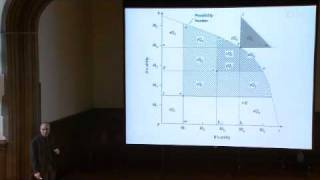
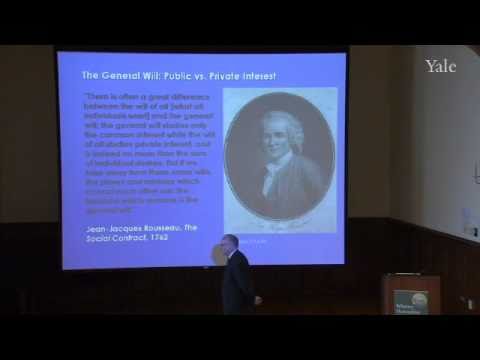
Yale political scientist Ian Shapiro continues his Moral Foundations of Politics course with a second lecture on majority rule and democratic competition. He asks what confers legitimacy on majority decisions, testing utilitarian justifications, Rousseau's idea of the general will, and the implications of Arrow's paradox for the meaning of voting results. Shapiro argues that crosscutting cleavages, introduced in the prior lecture, are what keep majority rule from becoming domination, since today's majority can become tomorrow's minority. The lecture works through Locke on majority rule, the public choice model of Buchanan and Tullock and its critique by Rae and Barry, Schumpeter's marketplace model of democracy, the Hotelling-Downs median voter theorem, and Huntington's two-turnover test. Chapter markers break the hour into discrete sections moving from theory to competing institutional models. Recorded in Spring 2010 as part of Yale's open course Political Science 118.