Democratic Justice: Applications
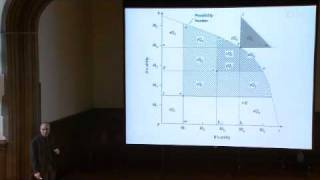
Ian Shapiro closes out his Yale course Moral Foundations of Politics by applying his theory of democratic justice to concrete cases. He examines governing children as a sphere where hierarchy is unavoidable, splitting authority between the state as fiduciary over basic interests and parents as fiduciaries over a child's best interests, a dual hierarchy that dissolves once the child reaches adulthood and self-determination. He then turns to workplace hierarchy, laying out his sliding scale between a Dickensian nightmare of high exit costs, which justifies heavy regulation, and a surfer's paradise of low exit costs and high social wage, where firms should be left to pursue efficiency. The lecture closes with his reflections on Tocqueville and the staying power of democracy. Recorded in Spring 2010, the session runs just under an hour and is organized into four chapters moving from family to firm to final remarks.