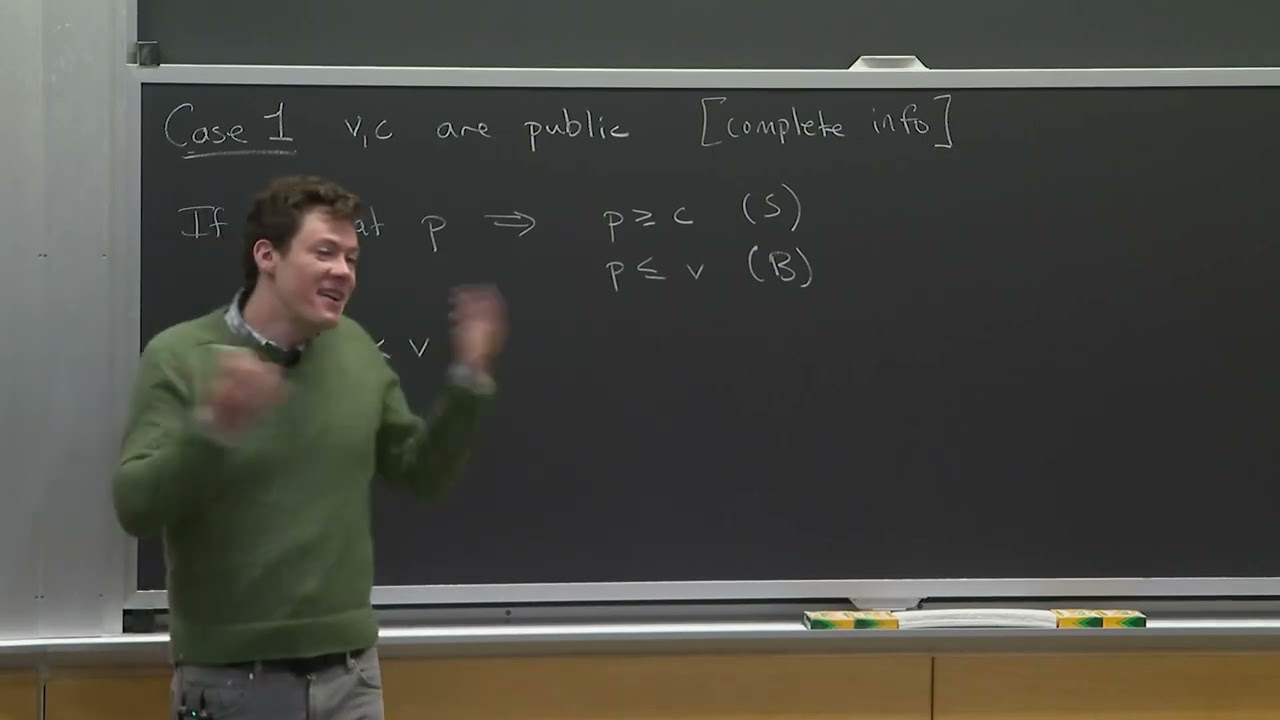
Lecture 23: Bargaining with Incomplete Information
Ian Ball continues MIT's 14.12 Economic Applications of Game Theory with a session on bargaining when one or both parties lack full knowledge of the other's private information. He builds out the formal model of incomplete-information bargaining, showing how uncertainty about a counterpart's valuation or reservation price changes the strategies available and the outcomes that result compared to bargaining under complete information. Plea bargains serve as a running real-world example, illustrating how a defendant's private knowledge of guilt or a prosecutor's private assessment of case strength shapes negotiation dynamics. The lecture works through the underlying game-theoretic mechanics on the board, keeping the analysis close to standard results in the field. Eighty minutes aimed at students already familiar with basic game theory who want to see how information asymmetry reshapes bargaining outcomes.