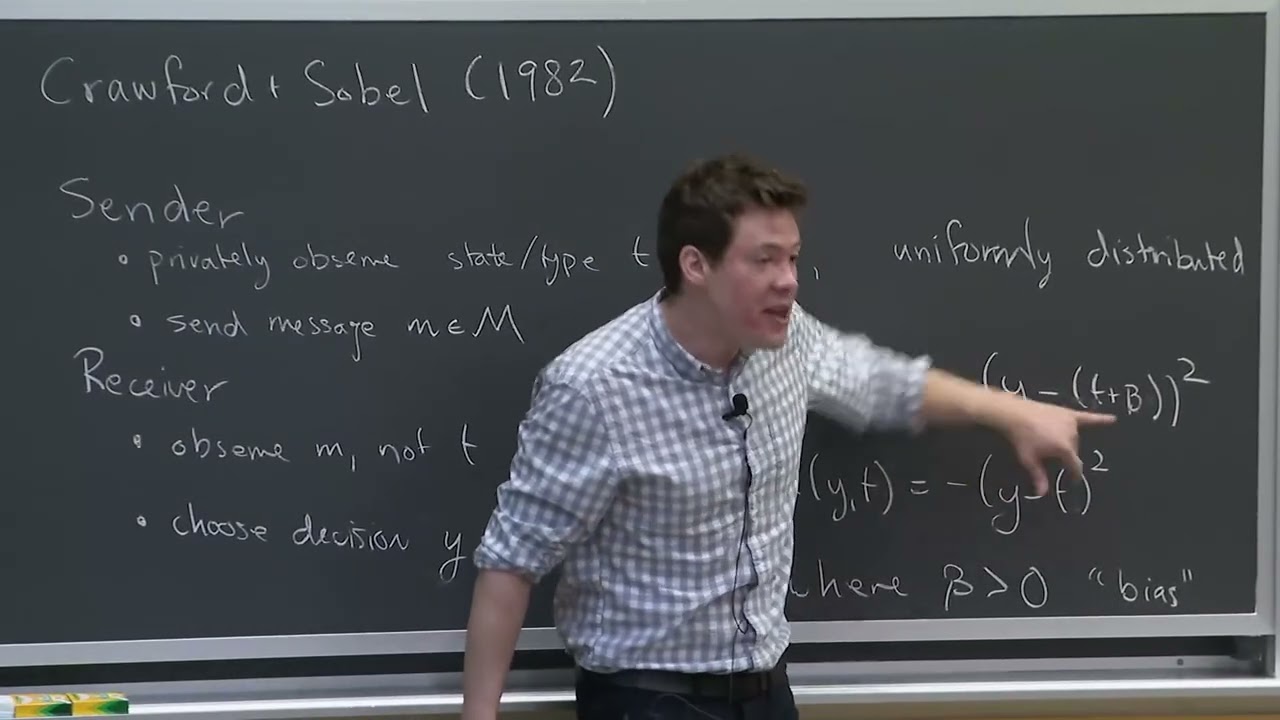
Lecture 24: Cheap Talk
Ian Ball teaches this session of MIT's 14.12 Economic Applications of Game Theory, covering cheap talk models in which players exchange costless messages that have no direct effect on payoffs. The lecture works through the strategic logic of communication when senders and receivers may have misaligned incentives, building on the Crawford-Sobel framework to show how much information can credibly transmit in equilibrium and why babbling equilibria always exist alongside more informative ones. Ball develops the conditions under which partition equilibria arise, how the number of induced actions depends on the degree of preference divergence between sender and receiver, and what this implies for real-world settings like expert advice, political rhetoric, and organizational communication. Runs 69 minutes as part of the Fall 2025 course sequence, continuing the course's game-theoretic treatment of strategic interaction into problems of information transmission.