Functional Groups and Fingerprints in IR Spectroscopy; Precession of Magnetic Nuclei
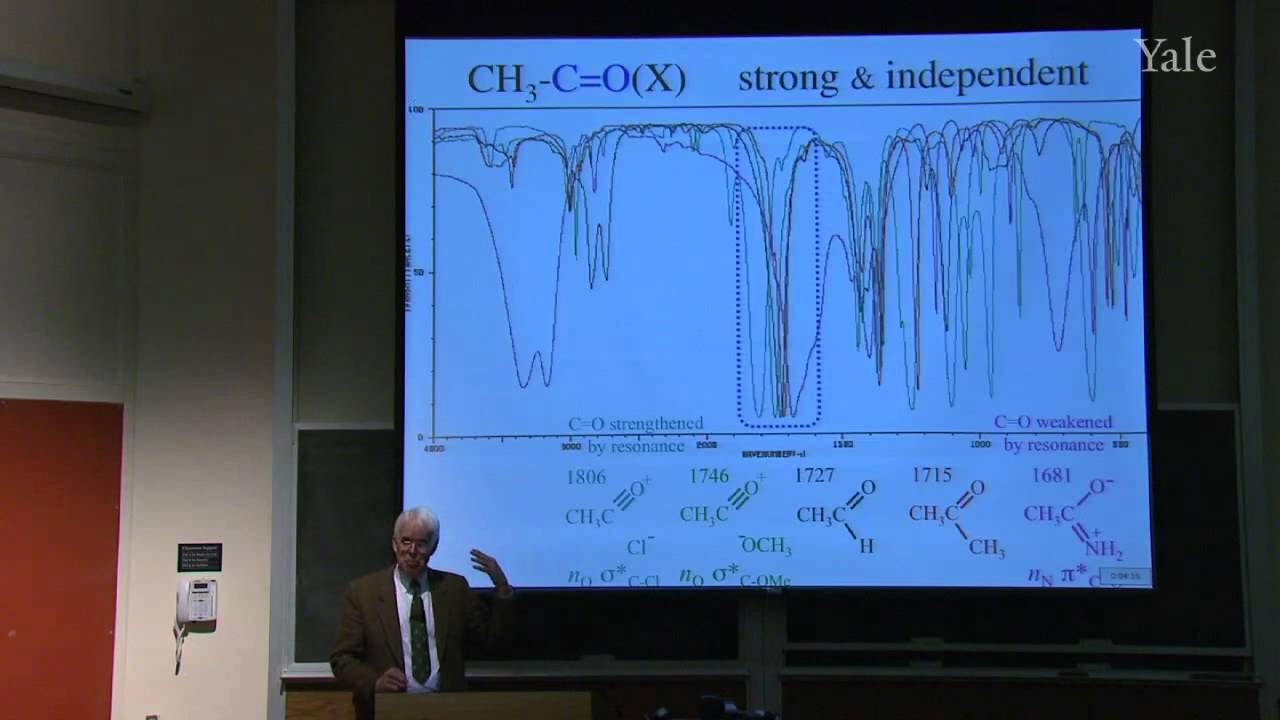
Michael McBride continues Yale's Freshman Organic Chemistry II with a lecture on infrared spectroscopy and nuclear magnetic resonance. He shows how the unusually strong multiple bonds in alkenes and alkynes give them distinctive stretching frequencies, and how out-of-plane C-H bending peaks reveal alkene configuration. Carbonyl stretching frequencies illustrate the effects of pi and sigma conjugation, and the complex fingerprint region is used to distinguish polymorphic crystalline forms of pharmaceuticals. The lecture then shifts to magnetic resonance, using the 90 degree phase lag between force and velocity to explain the precession of spinning tops and of magnetic nuclei in a field. McBride introduces the rotating frame as a way to visualize how a stationary magnet combined with a pulsed radio-frequency field drives nuclear precession, laying groundwork for NMR spectroscopy. Recorded in 2011 as part of the Open Yale Courses series.